
The Jobsite Changed. Your Patrol Didn’t. The Thieves Noticed.
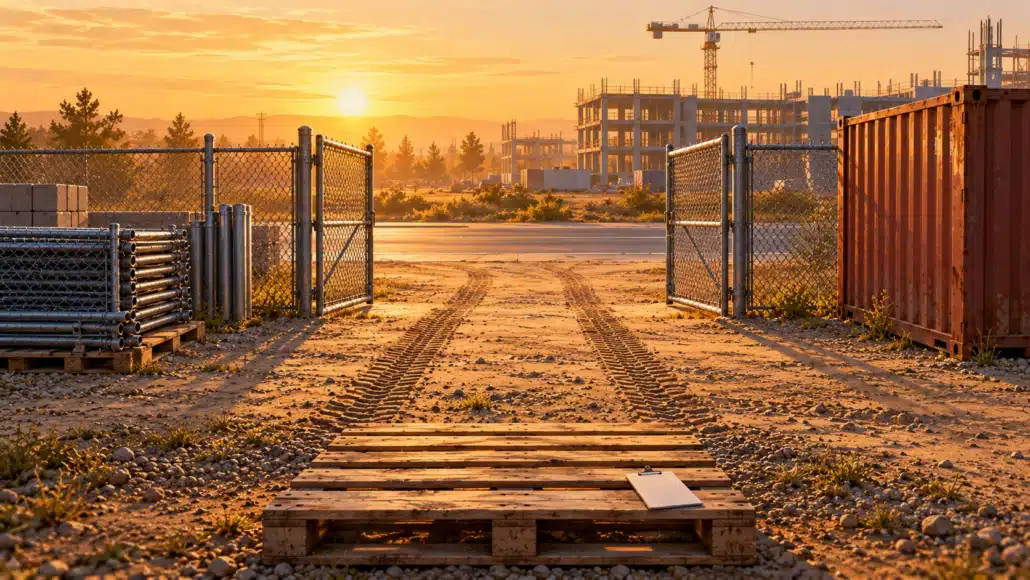
When construction site security patrols follow an outdated route, a completed round in the guard tour app can leave a new gate unchecked. Your security patrol software can record the assigned checks, but your team must keep the route aligned with the changing site. The investigation below leads to a site-change notice that connects the superintendent’s next change with revised post orders, checkpoints and an officer briefing.
Thursday, 2:30 p.m. The general contractor moves the delivery entrance. A crew drags eight fence panels thirty yards east, a new truck gate opens onto the west laydown yard, and the logistics coordinator tapes a revised site sketch to the trailer door. Trucks are using the new gate within the hour.
Nobody calls the security company. Nobody thinks to.
That night, your officer, Malik, walks the route in his post orders, the same route he has walked for eleven months. It sends him to the west-yard checkpoint at the old truck entrance. The new gate sits on the far side of a storage container, out of his line of sight and off his route. Nothing happens that night, or Friday, or over the weekend.
On Monday afternoon, the electrical subcontractor stages two reels of copper wire beside the new gate, because that’s where the trucks unload now.
At 6:07 Tuesday morning, Carmen, the electrical foreperson, walks into the west yard with her crew behind her. The pallet is empty. The cut list is still clipped to it. The new gate is standing open. Six electricians and a rented lift are about to spend the morning waiting for wire that isn’t coming.
Leah, the superintendent, calls you at 7:20. She isn’t asking a question so much as delivering a verdict: “The west yard is on your patrol. The gate was wide open, two reels are gone, and I’ve got a PM asking what we pay security for.”
She may be right. On a site that changes every week, though, part of the answer may be sitting in a document nobody updated.
Leah’s anger isn’t only about two reels. Thieves who find a way into an active site don’t always stop at the staged material. At a site on Hanlon Creek Boulevard in Guelph, Ontario, police were called one Wednesday morning after someone took a gate off its hinges overnight, smashed open a plywood barrier, and left with a spool of copper wire and more than 36 metres (about 118 feet) of wire that had already been installed in the building. An unsecured entrance can expose more than staged material: installed work may also be within reach.
You tell Leah you’ll have an answer by one o’clock. Then you start digging.
What your security guard reports say about Monday night
The instinct after a theft is to start with the officer: where was he, and when? On this construction site, start with the site instead. Begin at 6:07 a.m. and walk every record backward until you reach the last moment the site and your instructions matched.
That means collecting more than your own data. Pull the individual checkpoint entries from your guard tour system, not just the shift summary. Review the security guard daily activity reports from Thursday through Monday night, along with any incident reports. You’re looking for the first mention of the changed entrance, the staged copper, or a vehicle after hours.
Ask Leah’s team for their records: the after-hours access log, the delivery schedule, the logistics sketch, and any camera footage. Finally, open the post orders and check when they were last revised. If Malik uses a guard tour app, compare its assigned checkpoints with that sketch. A route can be completed exactly as configured while leaving Leah’s new entrance out of the patrol.
Interview Malik before showing him the records, and let him walk you through the night in order. He tells you two things that matter. He knew trucks had started using a new gate, but it wasn’t on his route and he hadn’t raised the mismatch. Around 1 a.m. he saw headlights near the west fence, assumed they were from an after-hours delivery, and didn’t log them. No one had given him a schedule or told him which trucks to expect.
Put everything on one page, newest first:
| When | Source | What it shows | What remains unanswered |
|---|---|---|---|
| Tue 6:07 a.m. | Carmen, electrical foreperson | Gate open; both reels gone | When the reels were taken, or how |
| Tue 2:41 a.m. | Checkpoint entry | A recorded visit to the west-yard checkpoint by the old entrance | What was happening at the new gate behind the container |
| Tue 1:05 a.m. | Site access log | A subcontractor’s keyholder lets a delivery truck in through the new gate | When the truck left, or who closed the gate |
| Tue about 1:00 a.m. | Malik’s account | Headlights near the west fence; not logged | Whose vehicle it was |
| Mon 11:09 p.m. | Checkpoint entry | A recorded visit to the west-yard checkpoint by the old entrance | Whether the new gate was shut |
| Mon 3:40 p.m. | Carmen’s crew | Two reels staged beside the new gate | Who accessed the materials afterward |
| Thu 2:30 p.m. | Logistics sketch on the trailer door | New truck gate opens onto the west yard | Whether anyone told security |
| All week | Post orders | Route still sends the officer to the old truck entrance | Who checked the route against the changed site |
A checkpoint entry records a check-in at the assigned point. It does not establish what Malik could see beyond the container or when the copper disappeared. Read the right-hand column and the theft stays unsolved. Read the rest of the table and you can explain why the new gate never became part of the route.
Two of the three gaps are yours
The table shows three gaps, and they don’t all belong to the same people.
The route didn’t change when the site did. The new gate opened on Thursday, and your post orders still described the site as it was before. Leah’s team should have told you. But the west yard is your assignment, and checking that the route still matches the yard is part of patrolling it. Five nights went by while Malik knew trucks were using an entrance he never checked. He didn’t raise the mismatch, and your supervisors didn’t catch it. That gap is yours.
Nobody owned the gate after the late delivery. A subcontractor’s keyholder opened it at 1:05. The access log records the truck coming in and nothing after it: no departure, no close-out, no name next to “secured.” Malik wasn’t told to expect that particular delivery, and the site had no rule for who closes the gate behind one. That gap is shared, and it’s the one most likely to start an argument, because the fix runs through Leah’s subcontractors.
Malik saw something and didn’t write it down. The headlights at 1 a.m. may well have been the delivery. They may not have been. A logged vehicle would have given everyone a time, a description, and a reason to look at the gate. That gap is yours too, and it calls for a training conversation with Malik, not just a reprimand.
If your team uses a security guard reporting app, use this moment in that conversation: “What would you record when you see a truck you weren’t told to expect?” Have Malik explain the observation, who he would contact, and where he would document the answer. The report needs to distinguish what he saw from what he assumed.
If the records had shown something simpler, such as a plain missed round or a patrol that did everything right, the conversation would follow the pattern any patrol firm faces after a disputed night. Construction adds a third possibility that’s built into the work itself: the site changed, and the paperwork didn’t.
The one o’clock call
When you call Leah back, lead with what’s yours. She’ll push, and she should.
You: We’ve finished the patrol review. When the new gate opened Thursday, our route didn’t change with it. Malik was still checking the old entrance, and from there the new gate is behind a container. That’s our miss. We should have caught it, and we didn’t. He also saw headlights near the west fence around one and didn’t log them. I’m handling that with him today.
Leah: So for five nights, nobody from your company looked at the gate my trucks use.
You: That’s right. I’m not going to argue it.
Leah: And the delivery? Your officer just let it happen?
You: He wasn’t told to expect that particular truck. Your access log shows a subcontractor’s keyholder letting a truck in at 1:05 and nothing after that. I’m not telling you that’s how the copper left. I don’t know that, and I won’t guess. What I do know is that nobody owns closing that gate after a late delivery, and that needs a name on it before tonight.
Leah: Fine. What happens tonight?
You: The new gate is on the route as of this shift, checked every round along with anything staged near it. A supervisor walks the first round with tonight’s officer. Every vehicle after hours gets logged. And I’d like twenty minutes on the west side with you at three, so we can write down who opens that gate at night, who closes it, and who checks it.
You had two easy outs on that call and took neither. Leah got two admissions, one honest open question, and a plan for the night.
Make the next site change reach your security guard app
At the three o’clock walk, Leah points to the trailer sketch. Your supervisor opens the assigned route in the security guard patrol app. They should describe the same site before tonight’s officer starts work.
Agree on a trigger: any change to a gate, fence line, staging area, or access point prompts a patrol review before the next shift starts. Give Leah a one-page site change notice. Her team fills in the first five fields when something moves. Yours completes the remaining four and gets her confirmation.
| Completed by | Field | Example entry |
|---|---|---|
| Site team | What changed | New truck gate on the west fence; old truck entrance closed |
| Site team | Where | Photo or marked-up site sketch |
| Site team | Effective | Thursday, 2:30 p.m. |
| Site team | What’s newly exposed | Material staging beside the new gate; open path to the building’s west side |
| Site team | After-hours access | Who may open the gate, who closes it, and who confirms it’s secured |
| Security | Patrol change | New-gate checkpoint added to every west-yard round; old-entrance checkpoint retired |
| Security | Post orders updated | By whom, and when |
| Security | Officers briefed | Names and time, before the next shift starts |
| Security | Site confirmation | Superintendent’s initials or a reply to the text |
A text with a photo is enough to start the notice. What matters is the deadline, because post orders that describe last month’s site are wrong no matter how neatly they’re written.
If your officers use a security patrol checkpoint app, test the revised tour at the new gate. Does the assigned route include it? Can the officer reach the checkpoint and inspect the entrance from there? Who gets called if a container blocks the view again? Your supervisor and Leah need those answers before they leave the yard.
While you’re there, ask Leah’s team to stage high-value material where the officer can inspect it during the round, or inside a locked container overnight. Agree on the gate-closing responsibility with the people who actually hold the keys.
The following Thursday
At 2:40 p.m., Leah’s logistics coordinator texts a photo: the east fence is moving twenty yards to make room for a crane pad. By 4:15, the security fields on the notice are complete. A new checkpoint goes on the east side, and the old one comes off the route. At 5:50, ten minutes before his shift, Malik is briefed on the change. His first scan at the new checkpoint comes in at 7:12 p.m.
Carmen’s replacement reels arrived on Wednesday. They spend their nights in a locked container now.
Nothing happens that night. This time, if something had, someone would have been looking in the right place.
Security guard patrol software for a changing jobsite
GuardMetrics is security guard software that supports guard tours and checkpoint records, site-level post orders available to assigned officers, mobile report forms for incidents and routine activity, and exception review for records that need a manager’s attention. For a jobsite like Leah’s, those are the places your managers can keep the assigned patrol and its supporting instructions aligned with the work outside.
The value of a guard tour app depends on the route your team puts into it. When an entrance moves, management must revise the tour and post orders, brief the officer, and check the result on site. Security guard reports then give the next review something concrete to examine. See how these workflows fit together for construction site security guard management.
If your firm protects active jobsites, book a GuardMetrics demo to see how your managers could keep tours, checkpoints, and post orders current on a site that changes every week. Recognizing the change and making sure the new instructions are followed remain your team’s responsibility.
